5 Telescope Control
System
5.1) Introduction
5.2) TCS
5.3) Starting the TCS System
5.3.1) TCS commands
5.3.1.1) Dome and Home buttoms (Popup windows)
5.3.2)
Taking dome flats
5.3.3) Opening
the dome, dark hatch
and mirror covers. (See
Appendix A)
5.4) Estop
5.5) Guiding
5.6) Hand paddle GUI
and telescope hardware hand paddle
5.7) When things do not
work properly
5.8) Closing (See
Appendix B)
________________________________________________________________________
5.1 Introduction
In 2008 a new Telescope Control System
(TCS) by Richard Treffers of Starman Systems, LLC was implemented.
The GUI is by Richard Pogge, OSU.
This chapter describes how to operate the new TCS. The telescope
can only be operated via the MDM 1.3m workstation. At some
point in the future, it is hoped that all operations can be performed remotely.
The observer will spend most of the time in the observing room where
the MDM 1.3m TCS GUI, xmis2 GUI and data acquisition
windows are located on mdm13ws1, with exceptions for dome shutter, dark hatch and E-stop operations.
5.2 TCS
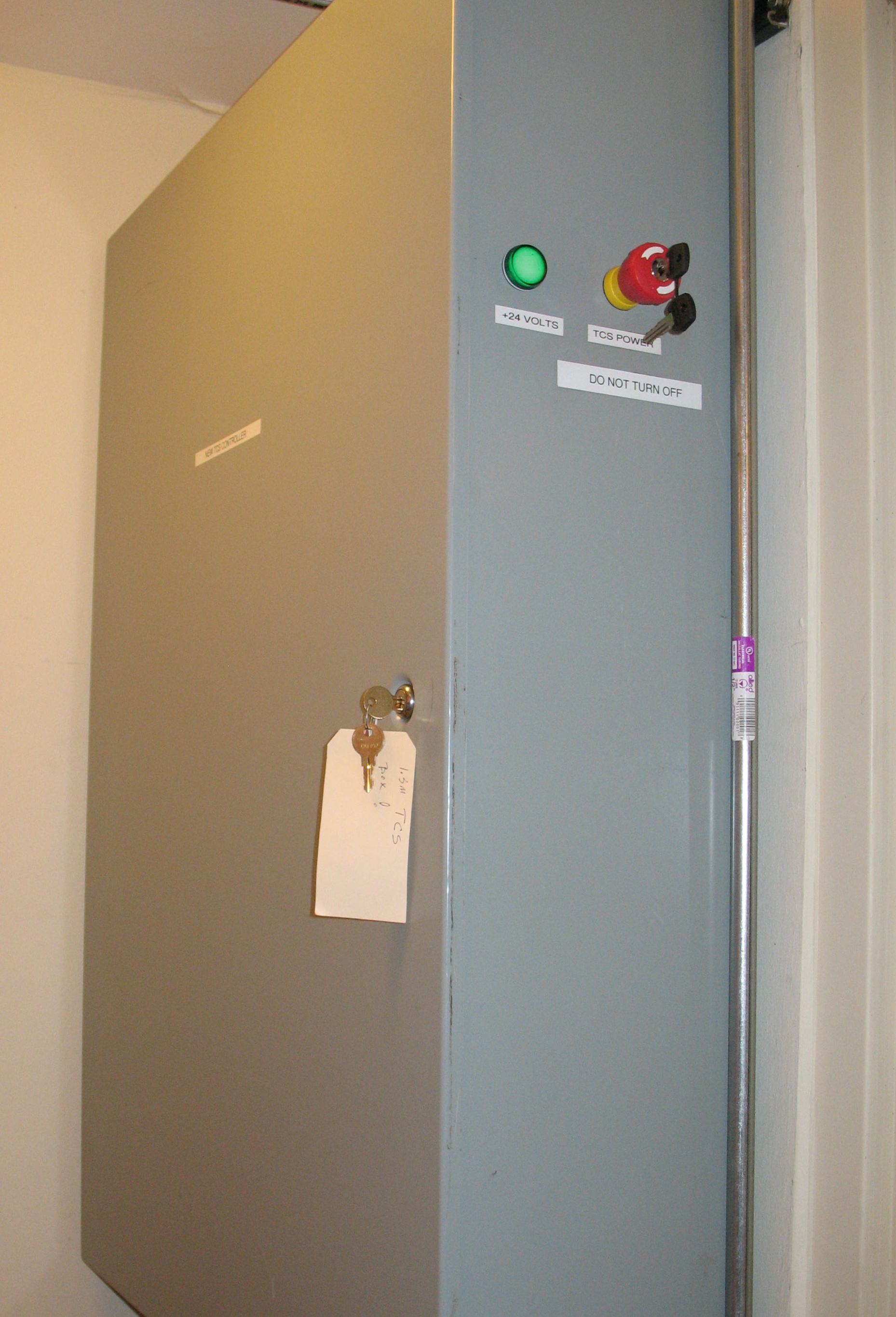
The TCS is a PMAC driven system and should never be turned off. If
it does get turned off, telescope RA, DEC, focus and dome
will
have to be homed.
5.3 Starting the TCS
system
Upon arrival, the
telescope and camera systems will most likely have been set up by MDM
staff. This information is good to browse however in case you
find yourself having to restart any systems during the night.
On mdm13ws1, before the TCS GUI is brought up, an
xterm window needs to be started to run the three severs.
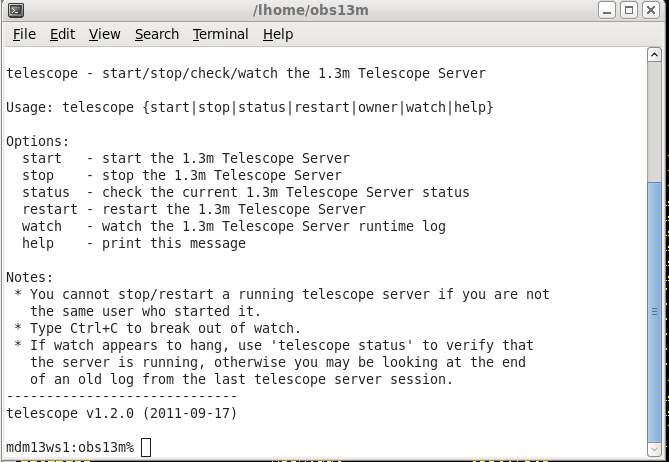
Once the xterm is brought up, the telescope servers (there are
three) need to be
started.
Type "telescope help". This will give information about the telescope. To start the
telescope type
"telescope start". This should tell you if the servers started.
This will start the telescope servers (tserver, rtel and rslit). The TCS GUI
can then be
started by clicking Applications, then Telescope Control, then MDM 1.3m TCS.
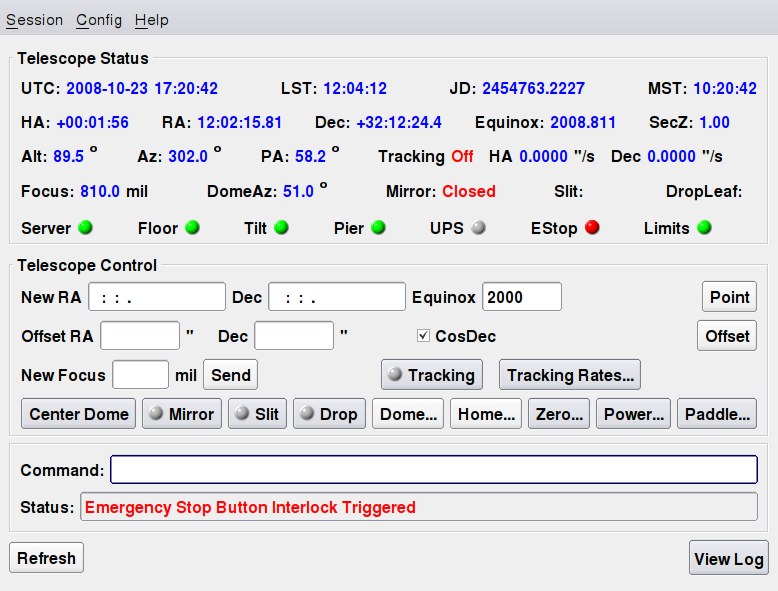
Once
telescope servers and GUI are up, click the Initialize button so that
the servers and GUI can talk to each other. Once initialized, telescope commands can be issued. A Refresh may be done at any
time when the telescope servers are running.
Once the GUI is brought up, the E-stop may be disabled, if it is not already. This is done in the dome by lightly turning
the red knob on the interface box clockwise (CW). If the knob LED
is lit, power to the telescope is cut. By turning the knob CW,
the light will go off and the telescope will be energized. To cut
power to the telescope, simply push the E-stop button in. This
will also relight the LED. Typically, it is ok to leave the E-stop disengaged when the telescope is not in use.
The Server, Floor, Tilt, Pier, Estop and Limits in the TCS GUI
should all be Green .
5.3.1 TCS
Commands
All of the commands can be typed in the Command: window of
the GUI if
need be.
1.3 Meter Telescope Commands
WARNING:
In order to avoid running the telescope into the pier safety trip
switch, certain safety protocols have been added to the TCS software code as well as to JSkyCalc13mGS.
Still, in the unlikely event that the limit is tripped, it is
relatively easy to get backed off the limit and back to observing by
utilizing this procedure.
It
is extremely unlikely that you will need to home the telescope or the
dome at any point during your time on the telescope. Only home
the RA, DEC, dome and focus if
needed, through the home
button in the GUI. Home one at a time or the telescope will lose connection!!
5.3.1.1 Dome and Home Buttons (Popup windows)
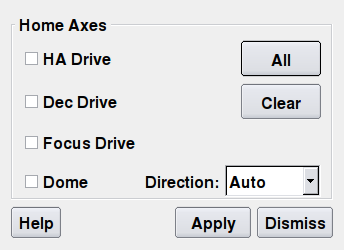
The
Dome and the Home buttons
on the TCS GUI will pop up windows that control the dome and send homing
commands to the
TCS.
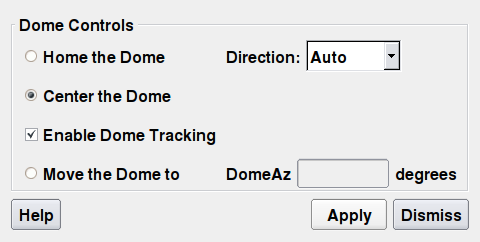
When raising or lowering the Dropout for mitigating wind shake, make
sure that the Enable Dome Tracking is unchecked so
the dome does not automatically move back to follow the telescope. The proper procedure follows:
1) Open the Dome Control Panel
2) Disable dome tracking by unchecking the "Enable Dome
Tracking" box
3) Home the dome
4) Open/close the dropout as needed
5) Enable dome tracking by checking that box
6) Choose Center the Dome to do it now rather than waiting for the keep-alive cycle time (60 sec)
Remember to check Dome Enable Tracking after you are through
raising or lowering the drop out so that the dome
can resume auto-tracking the telescope.
Again,
it is useful to note that unless something very strange has occurred,
it is extremely unlikely that you will ever need to home any telescope
or dome components during your time on the 1.3m telescope.
The Home Telescope and Dome panel window that pops up when the Home
button is pressed will send the different axes to their respective home
positions and set that axis to its home number (i.e. RA =0:00:00,
Dec =32:00:00, Dome =51 degrees, Focus =0).
It is imperative that you only home one item at a time!
Doing otherwise can lead to a disconnect with the telescope.
Home one item. When it is completed, uncheck it, check the
next item and home it, and so forth. You can click on View Log on the TCS GUI to watch for completion of each item.
5.3.2 Taking dome Flats
Dome flats
5.3.3
Opening
the dome, dark hatch and mirror covers
(See Appendix
A: Startup Checklist)
Make
sure the
dome is at
the home
position (contact boxes lined up) and open the dome from
the control
panel in the
dome. Make sure the E-stop is not engaged (i.e. no light). After opening the dome, open the dark hatch on
the MIS.
If
using the OSU filter wheel make sure the dark slide
is pulled out.
Once
the dome and dark
hatch are opened, return to the workstation and click the Mirror button on
the TCS GUI.
This
will open the
motorized mirror covers in about 40 seconds.
1.) Open dome first
2.)
Dark hatch and the dark slide if the OSU filter wheel is used.
3.)
Mirror covers last.
5.4 E-stop
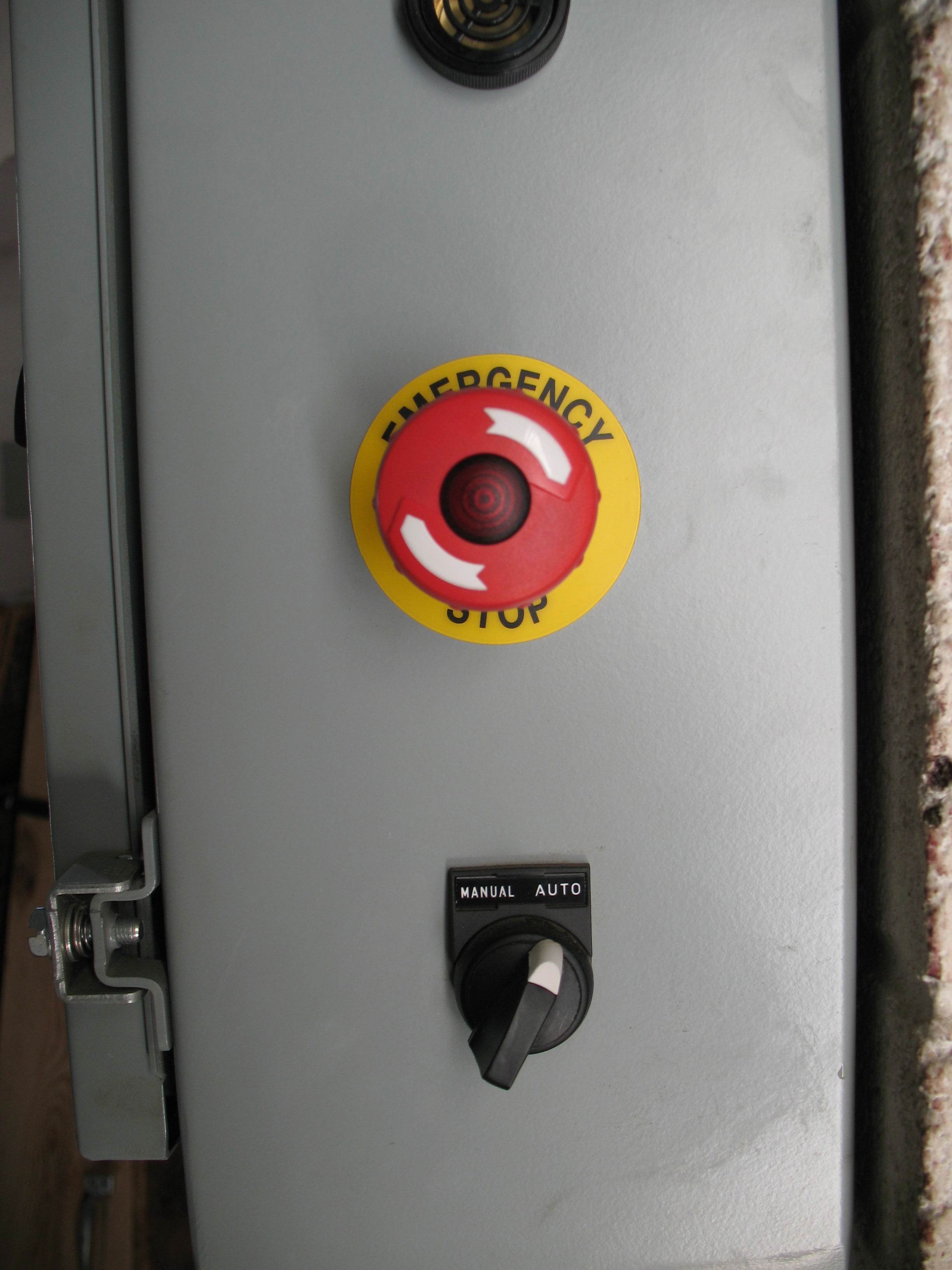
The E-stop is located
on the dome shutter control box in the dome next to the double
doors. It is no longer necessary to engage it in the morning.
The toggle switch below the E-stop allows user control of dome slit/dropleaf locally or remotely.
5.5
Auto-Guiding
1.3m Auto
Guiding
5.6 Hand paddle
GUI and
telescope hardware hand paddle
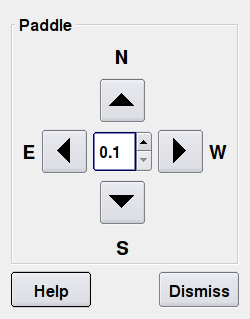
In
the TCS GUI there is a
panel button called Paddle.
This is the handpaddle GUI. The direction
button is a press and release as this just does an offset. If the
button in the sub GUI is held down it will give an error box. If
commands are issued without proper delay (~2 seconds), it will give
an error box.
With the hardware hand paddle, continuous holding of any direction
button will move the telescope in that direction. In order to use
the physical hand paddle, a command must be issued via the TCS GUI
first. For most motions, the command to be entered is as follows:
tx paddle type=50
Once
motions are completed with the physical hand paddle, GUI-based commands
should complete normally again upon desire. However, it is of
note that if after issuing computer commands to move the telescope, the
command above must be entered again if control from the physical hand
paddle is once again desired.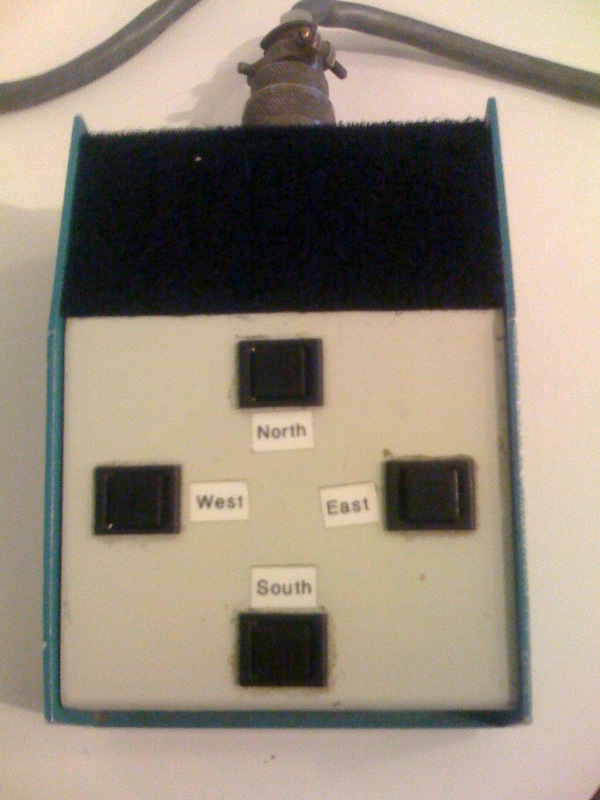
5.7 When things do not
work properly
If telescope motion fails, the
issue can typically be traced to one of two problems--either the port
server needs to be reset or the declination motor controller needs to
be power-cycled.
First try all the steps in the chapter just
to make sure that everything was done correctly.
Usually the
first thing to do is bring up an xterm window and type: telescope
status, to see if all the servers for the TCS are running
i.e.
tserver,
rtel and rslit . You should see: mdm13ws1:obs13m%
telescope status
MDM 1.3m telescope
services:
tserver: running on
hill owner=obs13m
rtel: running
on hill owner=obs13m
rslit: running
on hill owner=obs13m
If anything is not running, type telescope stop, then in a fews
seconds type telescope start and you should see everthing running.
If for some reason
the telescope
does not respond to commands in an xterm window try, type telescope stop and
then telescope start in a terminal window, as above, to make sure the servers are acting
correctly.
Then, dismiss the TCS GUI and restart it. Be sure to reinitialize using the Initialize button on the TCS GUI.
Occasionally, one or more of the servers may appear to start running
only to stop again almost immediately. This is indicative of an
issue with the port server hardware, located within the TCS enclosure
in the 1.3m computer room. While the procedure to reset the port
server is quite simple, it must be performed locally and the user must
know exactly what to reset. If this is necessary, follow the
steps outlined at the link "1.3m Port Server Reset" as found on the McGraw-Hill homepage.
If everything with the three server states appears correct, the problem
is likely the declination motor controller. If it becomes
necessary to reboot this controller, follow the steps outlined at the
link "1.3m Declination Motor Controller Reset"
as found on the McGraw-Hill homepage. As with the prt server
reset, while cycling this controller is relatively simple, it must be
performed locally.
For a detailed primer on reseting the telescope coordinates (pointing), follow the steps outlined at the link "1.3m Telescope Coordinates Reset" as found on the McGraw-Hill homepage.
When the
mirror covers do not seem to close when the telescope is not
functioning properly a manual close can be performed.
On
the west side
of the telescope there is a gray box that with a switch on
it. Switch to "On" and use the open/close switch to close the mirror
covers. This is all contingent on whether or not the box can be reached.
See Picture:
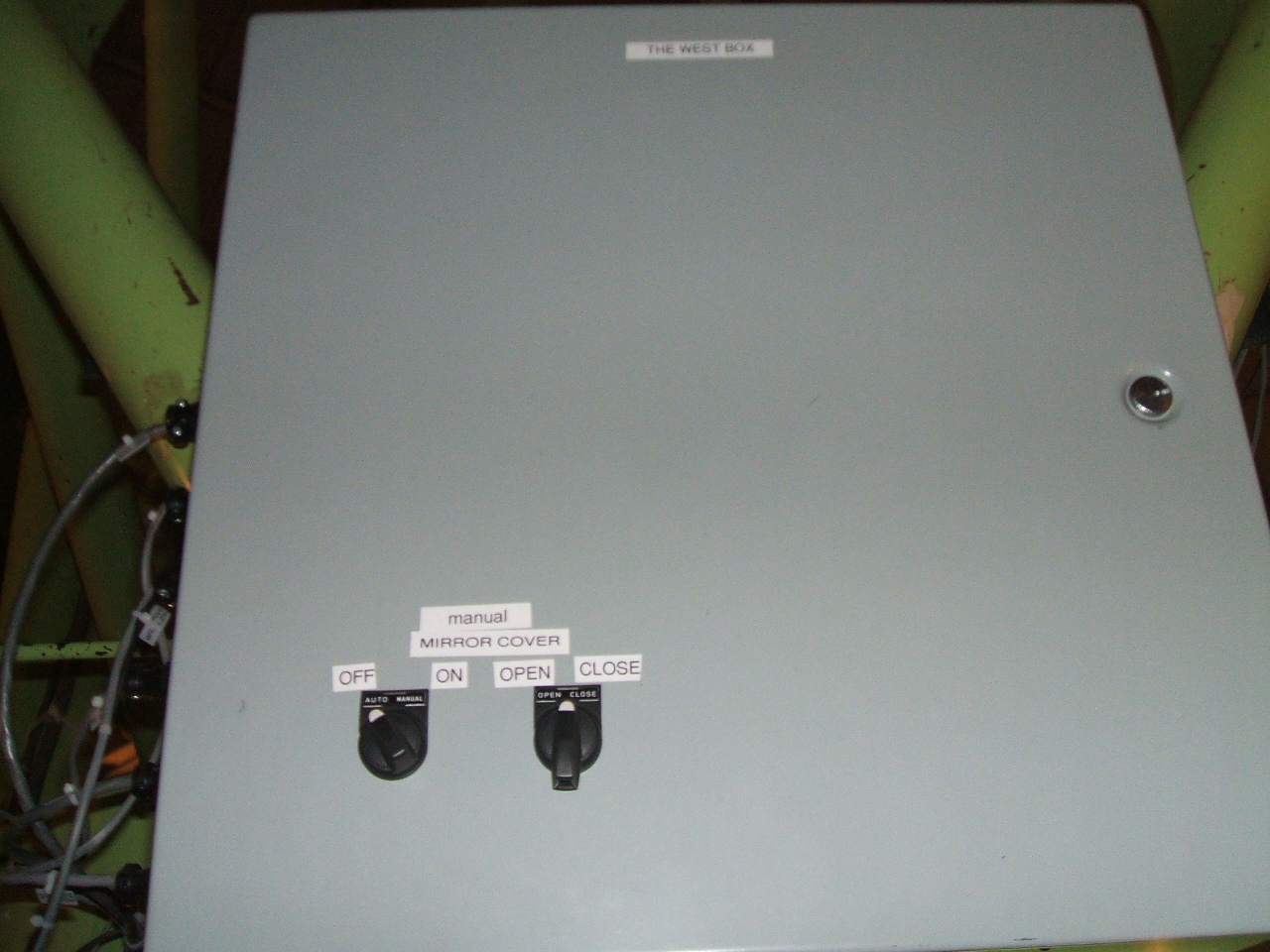
If everything looks as though
it
was done correctly, please contact the staff.
5.8
Closing up: (See Appendix B: Shutdown Checklist)
Updated:
2026Jun16 (Galayda/MDM)